Rich, or Just Acting Rich?
What Thomas Stanley found about how millionaires really spend — the cars, the houses, the absence of debt — and what his 2009 book means for a Canadian in 2026, with today’s numbers
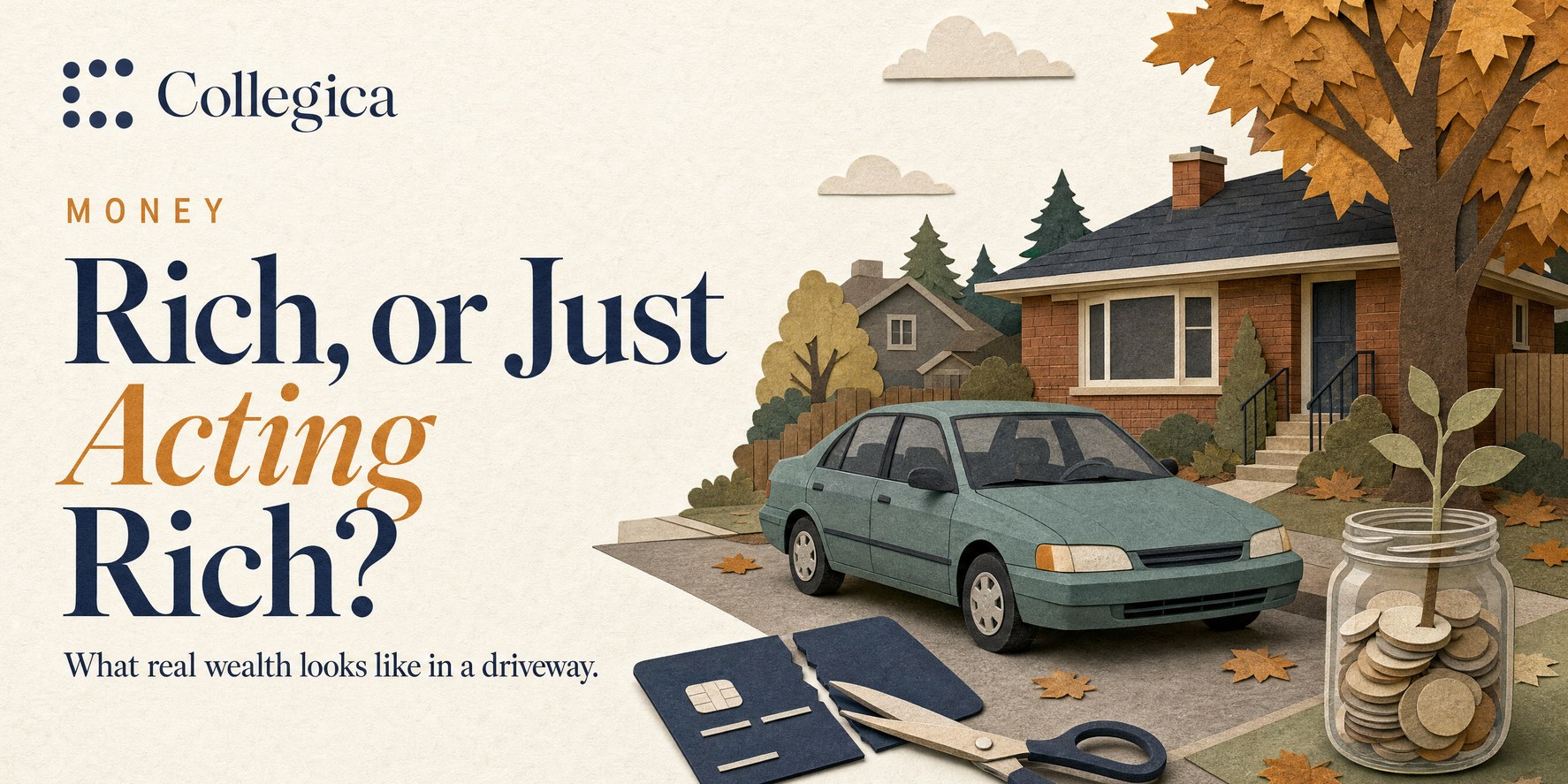
Picture a millionaire’s driveway. Most people imagine a German luxury car, leased, a year old. The researcher who spent his career surveying American millionaires found something else: the make they had bought most recently, more often than any other, was a Toyota. The median price they paid for their latest car was about US$31,000. And 86% of the people driving prestige cars were not millionaires at all.
That was Thomas J. Stanley, the marketing professor best known for The Millionaire Next Door (1996). In 2009 he published a sharper follow-up, Stop Acting Rich… And Start Living Like a Real Millionaire. Its target was a group he called aspirationals: people with good incomes who spend as if they were rich, “but actually aren’t rich”. Their cars, houses, watches and wine look like wealth. Their balance sheets don’t.
This article sets out what Stanley found, what his numbers do and don’t prove, and what they mean for a Canadian in 2026, when a new car costs 81% more than in 2009, households owe $1.76 for every dollar of disposable income, and a million dollars buys about a third less.
- Income is not wealth. Stanley’s whole argument rests on it: what you earn and what you spend show; what you keep doesn’t.
- Real millionaires, in his surveys, spent modestly. Toyota was the make they bought most; their median car cost about US$31,000; few leased; nearly three times as many lived in homes under $300,000 as in homes over $1 million.
- In Canada, prices have moved against the advice. The average new vehicle sold for $31,611 in 2009 and $57,142 in 2026, up 81% while prices in general rose 49%.
- “Millionaire” means less now. $1 million in 2009 is about $1.49 million today, and roughly three in ten Canadian families now have a net worth of $1 million or more, much of it in their home.
- The two quiet signs of wealth in the picture above are worth copying: a paid-off car you keep for years, and no credit card balance. A $5,000 card balance at 20.99%, paid at the minimum, takes about 21 years to clear.
Stanley’s figures are American, in US dollars, from a survey taken before the 2008 crash; the Canadian figures are dated and sourced. None of this knows your income, your city or your family. Where we did the arithmetic ourselves, we say so.
What Stanley found
Stanley’s book draws on a national survey of about 1,600 high-income and high-net-worth American households, taken around 2007, and on tax and census data. These are the findings he returned to most often, as reported on his own blog.
Cars: the clearest signal
- Toyota first. Toyota was “the number one make of motor vehicle most recently acquired by millionaires”, driven by more than one in ten of them.
- Modest prices. The median millionaire paid US$31,367 for their most recent vehicle; even those worth $10 million or more paid a median of US$41,997.
- Most prestige drivers aren’t rich. “86% of those who drive prestige makes of motor vehicles are not millionaires.”
- They buy, they don’t lease. Only 11.3% leased their latest car.
His point was not that Toyotas make you rich. It was that people who become rich tend to judge a car by what it does for the money, not by what it says about them, and that a large share of expensive cars are bought by people who can’t really afford them.
Homes: the biggest decision
- Smaller houses produce more millionaires. By Stanley’s estimates, about 1,138,000 American millionaire households lived in homes worth under $300,000, against about 403,000 in homes worth $1 million or more. (That is 28% of millionaire households in the cheaper homes, not “most”, as some summaries claim.)
- “Rule 1.49”. The median millionaire’s first home cost about 1.49 times their household income.
- Neighbourhood matters. A house in an expensive neighbourhood brings expensive neighbours, and the pressure to keep up with them.
The small things
His blog reports a median of about US$14.54 for a bottle of wine and US$149.50 for a watch among millionaires, and that about 40% have clothes altered rather than buying new. These figures are less certain: the posts don’t always say whether they come from the book’s survey.
Happiness
In his surveys, the people who said they could “easily afford their consumption lifestyle” were significantly happier than those acting rich. Among the strongest correlates of satisfaction were “I live well below my means” and investing 10% or more of income. He also found no make of car, among 46 studied, that measurably raised overall life satisfaction.
Income is not wealth
Stanley’s sharpest line: “income is not net worth, not wealth; wealth is not income.” A household earning $250,000 and spending it all is not wealthy. A household earning $90,000 and saving a fifth of it for twenty years may be.
His earlier book offered a rough yardstick:
Expected net worth = your age × your yearly pre-tax household income ÷ 10
A 45-year-old household earning $120,000 would “expect” $540,000. Well above that, Stanley called you a prodigious accumulator of wealth; well below, an under accumulator. It’s a crude rule from the 1990s, blind to student debt, house prices and when you started earning, but it asks the right question: given what you’ve earned, how much have you kept?
What has changed since 2009, in Canada
The prices
| 2009 | 2026 | Change | |
|---|---|---|---|
| Average new vehicle sold in Canada | $31,611 | $57,142 (Jan–Aug) | +81% |
| Consumer prices (CPI) | — | — | +49% |
| Household debt per $1 of disposable income | $1.64 | $1.76 (Q2) | +8% |
| $1,000,000 in 2009 dollars | $1,000,000 | about $1,486,000 | +49% |
New cars have risen far faster than prices in general. The household-debt ratio peaked at $1.88 in 2022 and has eased since, but total household debt reached $3.28 trillion, and average non-mortgage debt per Canadian consumer was $28,118 in mid-2026, up 7.6% in a year, with car loans the fastest-growing kind.
“Millionaire” isn’t what it was
Statistics Canada’s 2023 survey of wealth puts the median family’s net worth at $519,700. Working from its published brackets, we estimate that roughly 30–33% of Canadian families had a net worth of $1 million or more. StatCan doesn’t publish that count, and much of it is home equity in places like Toronto and Vancouver.
So Stanley’s word needs adjusting. Being a “millionaire” in 2026, on paper, often means owning a house that rose in value. The question he was really asking, whether you could stop working or weather a bad year, is better answered by what you own besides your home, and by what you owe.
Two quiet signs of wealth
A paid-off car you keep
Stanley’s millionaires bought modestly and kept their cars. Canada’s Financial Consumer Agency (FCAC) shows why that matters:
- Long loans cost more. On a $25,000 car at 5%, a 36-month loan costs $1,974 in interest; an 84-month loan, $4,681. FCAC counts anything of 72 months or more as long-term.
- New cars lose value fast: about 25% in the first year, then 15–25% a year for the next few years.
- Negative equity follows. In FCAC’s example, two years into an eight-year, $35,000 loan, the borrower owes $8,520 more than the car is worth.
In the US, Ramsey Solutions found in 2025 that 89% of people who paid cash for their car were happy with it, against 55% of those who financed it.
What the money could do instead (our arithmetic): $500 a month invested at 4% a year above inflation grows to about $73,600 in 10 years and $257,000 in 25, in today’s dollars. A TFSA lets it grow tax-free: the 2026 limit is $7,000, and someone eligible since 2009 has up to $109,000 of room.
No credit card balance
Ramsey’s study of US millionaires found that “nearly three-quarters” had never carried a credit card balance. Canadian cards typically charge around 20%, and paying only the minimum is what makes that rate so expensive.
Our calculation, for a $5,000 balance with a minimum payment of 3% of the balance (at least $10) and no new spending:
| Interest rate | Minimum payment only | A fixed $150 a month | A fixed $250 a month |
|---|---|---|---|
| 19.99% | about 20 years, $5,773 in interest | 50 months, $2,357 | 25 months, $1,132 |
| 20.99% | about 21 years, $6,434 in interest | 51 months, $2,568 | 25 months, $1,207 |
| 22.99% | about 24 years, $8,034 in interest | 54 months, $3,045 | 26 months, $1,366 |
The minimum shrinks as the balance shrinks, so it never catches up. Freezing the payment at the first month’s amount, $150, clears it in about four years instead of twenty. Card issuers set minimums differently; FCAC’s own example ($2,000 at 18%, minimum only) takes almost four years and costs $793. Buy-now-pay-later is the same trap with a friendlier face: FCAC warns its rate can jump from 0% to 35% after a missed payment.
Where the book is weaker
- Survivorship bias. Stanley surveyed people who are already millionaires and found they were frugal. He didn’t follow frugal people who never got rich. Nassim Taleb made this criticism of The Millionaire Next Door, and it applies here too: the habits may help, but the surveys can’t prove they cause wealth.
- A pre-crash snapshot. The survey predates 2008 and the long rise in house prices that followed. A $300,000 house was ordinary then; in most Canadian cities today it is rare.
- American data. The car, wine and watch figures are US dollars from US households.
- His own segments. “Aspirationals” and “glittering rich” are Stanley’s categories, built from his own mail surveys, which report counts but not response rates.
None of that undoes the central point, which needs no survey to prove: money spent on looking rich is money that can’t compound.
What to do this week
- Work out your net worth: everything you own minus everything you owe. Then do it again without the house.
- Try Stanley’s yardstick (age × income ÷ 10) for a rough sense of direction, not a verdict.
- Look up your card’s interest rate, and if there is a balance, set a fixed monthly payment instead of the minimum.
- Before your next car, price the whole loan (interest included) and the first three years of depreciation, and compare it with a two- or three-year-old version of the same car.
- Write down what you buy to be seen. Not to stop all of it, but to choose it on purpose.
Sources
Research notes recording what was read in full, what came from Stanley’s blog rather than the book, and what could not be verified (including the book’s appendix, which couldn’t be read online) are in the accompanying folder.
- The book and its findings. Thomas J. Stanley, Stop Acting Rich… And Start Living Like a Real Millionaire, Wiley, 2009 (Internet Archive record); Stanley’s blog posts quoting it: aspirationals and leasing, rich or drive rich, Toyota first among millionaires, cars and life satisfaction, superior neighbourhood, Millionaire Rule 1.49, wine, watches, to be happy, stop acting rich, the median millionaire; Thomas J. Stanley, 1944–2015.
- The yardstick and the critique. The Millionaire Next Door (Wikipedia), for the expected-net-worth formula and Taleb’s survivorship-bias criticism.
- Canada. Statistics Canada, household debt to disposable income, new motor vehicle sales, consumer price index, net worth by age (Survey of Financial Security 2023), net worth by decile; TransUnion Canada, consumer debt, Q2 2026; FCAC, risks of car financing, paying off a credit card, buy now, pay later; CRA, TFSA and RRSP limits.
- US comparators. Ramsey Solutions, National Study of Millionaires (surveyed 2017–18) and State of Personal Finance, Q3 2025.